
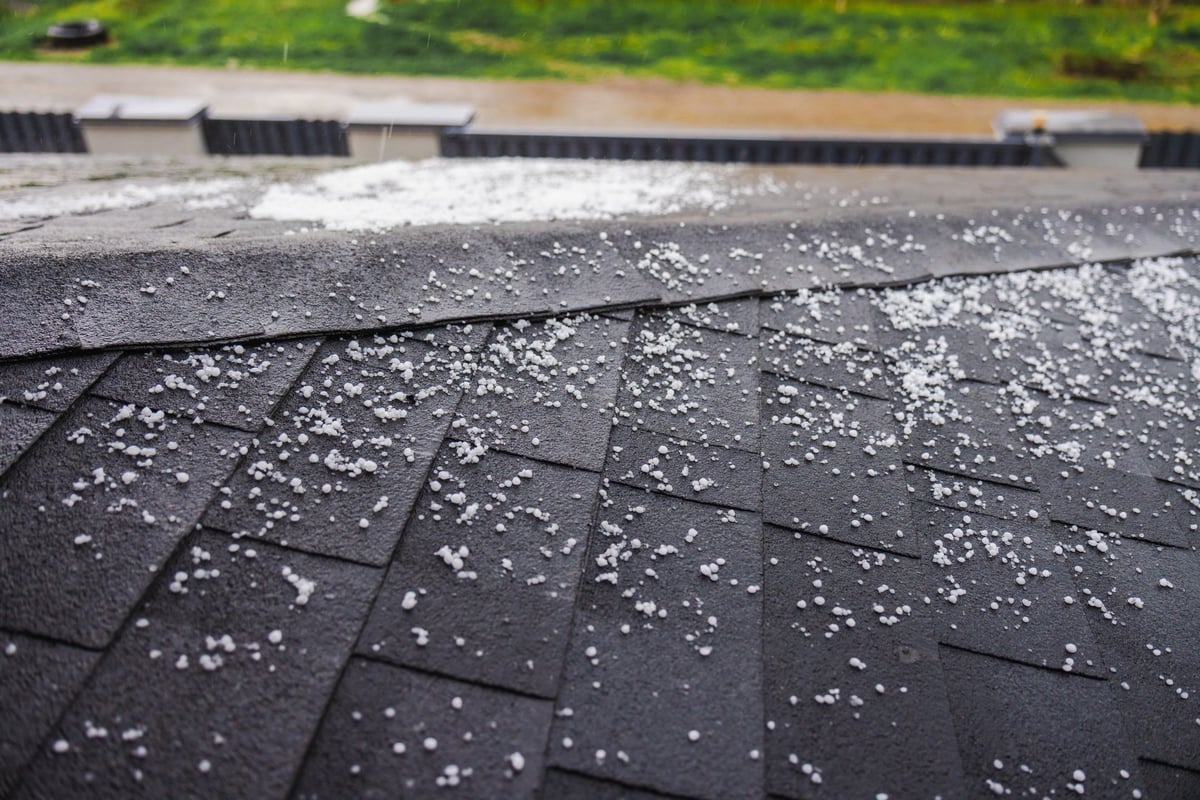
A hailstorm rolls through your neighborhood at two in the afternoon. It lasts maybe eight minutes. By dinnertime the sun is out, your car looks fine, and you go back to whatever you were doing. Six months later, a brown water stain appears on your bedroom ceiling — and suddenly that eight-minute storm is a $12,000 problem your insurance adjuster is reluctant to cover because you waited too long to report it.
That is the thing about hail damage on a roof: it is almost never dramatic. You don't see shingles scattered across the lawn. You don't hear water dripping into the attic the next morning. What you get is cumulative, slow-moving, and expensive when ignored. Homeowners across the Mid-South — from Memphis to Southaven, Jonesboro to Paragould — learn this the hard way every spring. Our job is to make sure you are not one of them.
At North Slope Exteriors, we inspect hundreds of roofs a year across Tennessee, Arkansas, and Mississippi. A solid majority of the hail damage we find was invisible from the ground. The homeowner had no idea. This guide will walk you through exactly what hail damage looks like on different roofing materials, how to check for it safely, when to call a roofer, and how the insurance process works when you do file a claim.
What Hail Damage Actually Looks Like (By Roof Type)
Hail doesn't damage every roof the same way. The material, the age of the roof, the size of the stones, and the wind speed all change what you'll see. Here's the breakdown.
Asphalt Shingles — The Most Common Roof in the Mid-South
Asphalt shingles take hail damage as localized granule loss. A hailstone hits the shingle and knocks the protective mineral granules off the asphalt mat, leaving behind a dark, circular bruise that feels soft or spongy to the touch — like a small divot in the shingle surface. Run your palm over a fresh impact and you'll feel it: a slight depression where granules are missing and the asphalt substrate is exposed.
Here's what throws people off: these bruises can be the size of a dime or a quarter, and from the ground they are invisible. You need to be on the roof — or at least on a ladder at the eave line — to see them clearly. In direct sunlight, fresh hail hits on asphalt shingles can have a slight sheen where the asphalt is newly exposed. Older impacts weather to a dull gray and blend in with the surrounding granules, making them even harder to spot a year or two after the storm.
Other signs on asphalt roofs include:
- Granules in the gutters or at downspout outlets. A small amount of granule shed is normal for an aging roof. A heavy accumulation that looks like coarse black sand, especially right after a storm, is a red flag.
- Cracked or fractured shingle edges where large hail — golf-ball size or bigger — has physically broken the shingle mat.
- Dents or dings on ridge caps, which sit at the highest point of the roof and take the brunt of a hailstorm.
Metal Roofs — Tougher, But Not Immune
A standing seam metal roof will laugh off pea-sized hail. But quarter-sized hail and larger can leave visible dents, especially on the flat pans between the seams. These dents are cosmetic in most cases — they don't leak — but they do reduce curb appeal and resale value. If your metal roof is under warranty, check the fine print. Some manufacturers require reporting hail damage within a specific window to maintain coverage.
Metal roofs on homes in the hail belt between Jonesboro and Memphis take a beating over time. A single storm might not look like much. Three storms over five years, though, and the cumulative denting becomes visible from the street. If you've got a metal roof and a hailstorm just came through, get eyes on it. Replacement panels are far cheaper than a full reroof, and catching damage early keeps the repair scope small.
Wood Shakes and Slate
Hail splits wood shakes along the grain. It's sharp and unmistakable — a fresh split in a cedar shake after a storm is almost certainly hail. Slate tiles crack or shatter depending on the hail size. Both materials are less common in the Mid-South than asphalt and metal, but they show up on higher-end homes in Germantown, Collierville, and East Memphis. The same rules apply: inspect after every significant hail event, and don't assume your premium material is bulletproof.
How to Check Your Roof for Hail Damage — Safely
Before we go any further: do not climb onto your roof unless you are trained and equipped to do so. A wet asphalt roof after a storm is slick. A 6/12 pitch is steeper than it looks from the ground. Falls from roof height are disabling or fatal. If you are not comfortable on a ladder, skip straight to calling us at (870) 218-4440. The inspection is free. The hospital bill won't be.
That said, here is what you can check safely from the ground or a stepladder:
1. Walk the Perimeter and Look at the Gutters
Dents on aluminum gutters, gutter screens, or downspouts are the single best ground-level indicator of hail impact. Aluminum is softer than shingle granules — if the hail was big enough to dent a gutter, it was big enough to bruise a shingle. Look for clusters of circular dings, not just one or two isolated marks. Check the fascia trim and window screens while you're at it.
2. Check Soft Metals Around the Property
Your air conditioner condenser fins, exterior light fixtures, mailbox, and shed vents are all hail indicators. If these show fresh dents, your roof almost certainly does too. This is especially useful for homeowners in Paragould and Jonesboro, where spring storms can drop hail on one side of town and leave the other untouched. Soft-metal damage on your property pins the hail to your specific address.
3. Inspect the Attic
Go into your attic on a bright, sunny day and turn off any lights. Look up. If you see pinpoints of daylight through the roof deck, those are penetration points — and they were probably not there before the last big storm. While you're up there, check the underside of the decking for dark water stains, especially around vents, chimneys, and valley lines. Water follows the path of least resistance, so a stain might be several feet from the actual leak point.
4. Look for Granules at the Downspout
After a hailstorm, check where your downspouts discharge. A heavy granule deposit — dark, gritty, sand-like material — means your shingles shed their protective layer during the impact. This is cumulative damage. Each storm strips more granules, and eventually the asphalt mat underneath is exposed to UV and moisture. Once that happens, the shingle fails fast.
Why the Mid-South Gets Hit Harder Than Most
The Mid-South hail belt is not a myth. It is a meteorological pattern that runs from central Oklahoma through Arkansas into West Tennessee and North Mississippi, driven by the collision of warm Gulf moisture with cold fronts dropping out of the Plains. Spring and early summer are the active months — March through June, peaking in April and May. If you live in Memphis, Southaven, Jonesboro, or anywhere within fifty miles of the Mississippi River corridor, your roof has statistically been in the path of qualifying hail at least once in the past five years.
The humidity factor is what separates Mid-South hail damage from hail damage in, say, Colorado or Nebraska. Out west, a roof dries out after a storm. Here, the moisture hangs around. A hail bruise that exposes the asphalt mat on a shingle becomes an entry point for humidity-driven deterioration — the shingle absorbs moisture from the air, the mat swells and contracts through freeze-thaw cycles in January, and three years later a small impact bruise has become a slow leak. This is not a hypothetical scenario. Our crews have torn off roofs in Jonesboro where the decking was rotted through directly beneath hail-impact clusters that were four years old and had never been filed.
The insurance clock starts ticking the day of the storm. Most carriers require you to file within twelve months. If your neighborhood got hit in April, do not wait until the following March to call. The adjuster will ask why you waited, and "I didn't notice" weakens your position — even when it is the honest answer.
How North Slope Exteriors Actually Runs a Hail Inspection
When you call us for a hail inspection, here is exactly what happens — no vagueness, no sales routine.
First, we pull storm data. Before we even get on the ladder, we pull NOAA storm-date records for your specific address. We want to know: when did hail last hit this property, what was the largest recorded stone size, and did neighboring properties file claims? If the address has no qualifying storm event in the past twelve months, we will tell you that upfront and recommend a standard maintenance inspection instead. We are not going to manufacture a claim where one doesn't exist.
Then we walk the roof. Our inspector gets on the roof — not just a drone flyover, not just a ladder at the eave. We walk every plane, marking hail impacts with chalk circles and photographing each one. We check the ridge caps, the valleys, the flashing, the soft metals, and the attic ventilation while we are up there.
We document everything. You get a report with dated photographs of every impact cluster we find, plus photos of collateral damage: dented gutters, dinged fascia, damaged window screens, hail-splattered A/C fins. Insurance adjusters respond to evidence, not assertions. The more documentation we hand them, the fewer questions they ask.
We give you a straight answer. If the damage qualifies for a claim under your policy, we tell you. We will walk you through what to expect from the adjuster, we will meet them on site at no charge, and we will handle supplements if the initial settlement comes in light. If the damage does NOT qualify — maybe the hail was too small, maybe the shingles held up, maybe the storm missed your specific street — we tell you that too. We would rather earn your trust for the next one than sell you a roof you don't need today. That is how we have built our reputation from Memphis to Little Rock, and it is why most of our business comes from referrals.
What Hail Damage Costs When You Wait
Here is the number nobody wants to hear: a roof replacement that insurance would have covered at 100% minus your deductible becomes a $9,000 to $16,000 out-of-pocket expense the day your claim window closes. If the decking underneath has rotted from slow moisture intrusion over multiple seasons, add another $1,500 to $3,500 for sheathing replacement. And if the leak reaches your insulation or drywall, you are looking at interior repairs on top of the roofing work — easily another $2,000 to $5,000 depending on the extent of the water damage.
The financial gap between "I called after the storm" and "I waited two years" is routinely $10,000 or more. Our storm damage restoration page walks through the full claims process, but the short version is this: hail damage is a covered peril on nearly every standard homeowners policy in Arkansas, Tennessee, and Mississippi. The carrier pays for the replacement minus your deductible. You pay $1,000 or $2,500 instead of $12,000. That is the difference a free inspection makes.
We have seen too many homeowners in the Mid-South pay full freight for a roof that should have been an insurance claim — not because the carrier denied it, but because they never filed. Our roofing services cover both insurance and retail replacements, and we will be honest about which bucket your roof falls into after we inspect it.
When to Call Us
You do not need to be certain there is damage. That is what the inspection is for. But here are the moments when picking up the phone is the right move:
- It hailed at your house — period. If you saw ice falling from the sky and it was pea-sized or bigger, call. Even if the roof looks fine from the driveway. Most hail damage is invisible from the ground.
- Your neighbor is getting a new roof through insurance. Hail swaths are typically a half-mile to two miles wide and several miles long. If three houses on your block got approved for replacements, yours almost certainly has qualifying damage. Do not be the last house on the street to file — it raises questions with the adjuster.
- You found granules in your gutters or at your downspout outlets. One heavy granule deposit after a storm is a strong indicator of hail impact. Multiple deposits over several seasons mean your shingles are losing their protective layer faster than they should.
- Your roof is ten years old or older. Older shingles are more vulnerable to hail because the asphalt mat has oxidized and the granule bond has weakened. A storm that a brand-new roof shrugs off can cause legitimate damage to a fifteen-year-old roof. Age matters when the adjuster evaluates the claim, but it does not automatically disqualify you.
- You are planning to sell your home in the next two years. A roof with undisclosed hail damage becomes a negotiation point during the buyer's inspection. They will ask for a credit, and you will be stuck paying for a replacement out of your sale proceeds instead of through insurance. Get ahead of it now.
For homeowners in Jonesboro specifically, our Jonesboro roofing page covers storm patterns and claim history for that market. For the Memphis metro, see our Memphis roofing page.
Frequently Asked Questions
What does hail damage look like on a roof?
On asphalt shingles, hail damage appears as dark, circular bruises where granules have been knocked off, exposing the asphalt mat underneath. The impact site feels soft or spongy — like a small divot — when you run your hand over it. On metal roofs, look for round dents. On wood shakes, look for fresh splits along the grain. The damage is subtle. Most homeowners never see it from the ground. A professional inspection with a trained eye and good light is the only reliable way to know.
How big does hail need to be to damage a roof?
Hail 1 inch in diameter — quarter-sized — or larger will damage asphalt shingles in most cases. But the size of the stone is only one variable. Wind speed, hail density, roof age, and shingle condition all factor in. We have documented legitimate hail damage from dime-sized hail driven by 50 mph wind gusts in a line squall that rolled through Southaven. Do not self-diagnose based on hail size alone. Let a roofer look.
How long after a hailstorm can I file an insurance claim?
Most standard homeowners policies in Arkansas, Tennessee, and Mississippi require you to file a hail damage claim within 12 months of the storm date. Some carriers — especially regional insurers — have shorter windows of 6 months. Check your policy or call us at (870) 218-4440 and we can help you look it up. The important thing: do not wait. A claim filed within 30 days of the storm has a much smoother path than one filed eleven months later.
Can I spot hail damage from the ground?
Sometimes, but not reliably. You may see dents on gutters, downspouts, fascia trim, or window screens — those are strong collateral indicators. But shingle-level damage requires being on the roof surface in good light, preferably in the morning or late afternoon when low-angle sun highlights impact depressions. A free inspection from a trained roofing contractor is the only way to know for certain whether you have damage worth filing a claim over.
Does North Slope Exteriors charge for a hail damage inspection?
No. We inspect your roof for hail damage at no cost and with no obligation. If we find qualifying damage, we walk you through the claim — documentation, adjuster meeting, supplements — at no out-of-pocket cost beyond your deductible. If we don't find damage, we tell you straight and we leave. We have built our business in Memphis, Jonesboro, and across the Mid-South on referrals, and you don't get referrals by selling roofs people don't need.
Don't Guess. Know.
If hail hit your neighborhood, your roof took the worst of it — whether you can see it or not. We'll inspect every shingle, document every impact, and tell you honestly whether you have a claim. Free. No pressure. Same answer you'd get from a neighbor who happens to be a roofer.
Get My Free InspectionOr call (870) 218-4440 — we answer the phone.